
Precision Lung Image Intelligence

Robust modular AI technology
LungQ® – our modular technology portfolio of advanced deep-learning algorithms for thoracic image analysis – offers market-unique segmentation and quantification capabilities for comprehensive assessment of lung anatomy and diseased lung regions.
Designed to handle image variability, the algorithms are optimized across therapeutic areas and clinical applications to ensure reproducible performance in real-world settings.
Extensively validated across diseases and patient populations, LungQ® analyses deliver precise quantitative insights to support translational research, drug development, and minimally invasive interventional therapies.

Precise identification of anatomical structures and disease patterns
Powered by advanced lobe-to-subsegmental segmentation and sensitive, accurate measurements LungQ is built on deep expertise in thoracic image analysis.
Consistently high performance, optimized for clinical impact
Backed by robust algorithm engineering and validation in a wide range of diseases and patient populations, our platform delivers reliable results for clinically meaningful solutions.
Scalable capabilities, adoptable across clinical contexts
Enabled by a modular design that supports flexible integration into diverse workflows, applicability is ensured across use cases and therapeutic areas.

Parenchymal analysis
Providing assessment of parenchymal texture patterns and estimated chronic perfusion defects.
Delivering critical information for treatment of emphysema, lung cancer, ILD, and other lung diseases.
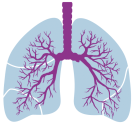
Bronchial analysis
Enabling deep exploration of bronchial anatomical structures and underlying mechanisms of airway disease such as cystic fibrosis, severe asthma, bronchiectasis disease, COPD, and other.
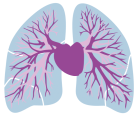
Vascular analysis
Uncovering novel insights into pulmonary arterial and venous volume changes throughout the entire vascular tree, supporting treatment of pulmonary vascular diseases related to PH, COPD, and ILD.
Advanced anatomical segmentation
Accurate segmentation forms a critical basis for an accurate identification of anatomical lung structures and disease distribution at global and regional level.
In combination with localization of anatomy, our advanced anatomical segmentation algorithms are optimized to accurately identify parenchymal, bronchial, and vascular anatomy with high sensitivity, extending down to pulmonary subsegments, interlobar fissures, distal airway branches, pulmonary arteries and veins.
LUNG lobes
pulmonary segments
BRONCHIAL TREE
ARTERIES & VEINS
High-fidelity quantification
Based on accurate segmentation, LungQ® quantification capabilities provide an objective view on disease distribution and changes over time related to disease progression and treatment effect.
- Parenchymal density
- Lung volume
- Collateral ventilation
- Emphysema
- Air trapping
- Estimated perfusion defects
- Tissue abnormalities
- Bronchial dimensions
- Bronchus-Artery ratios
- Mucus plugs count & volume
- Bronchial wall thickening
- Bronchial dilatation
- Bronchial narrowing
- Mucus impaction
- Pulmonary arterial &
venous dimensions - Vascular volumes
- Pulmonary vascular
volume shifts - Arterial dilatation
- Artery-Vein phenotyping
Comprehensive intelligence for precision medicine
Examples of LungQ® analyses:
Mucus Plugs Volume and Distribution
Emphysema Scoring per Lobe
Fissure Completeness
Pulmonary Vasculature Characterization
Bronchial thickening segmental assessment
Note: Thirona’s LungQ® technology platform offers a portfolio of measurements and analytical capabilities intended for either clinical use or clinical research . Availability and intended use of the analysis may vary by geography. Please contact us for further information regarding the latest regulatory status in your specific market and its suitability for your intended use.
Learn more about our flagship analyses

Bronchus-Artery
Analysis
Analysis
LungQ® BA performs fully automated quantification of the entire bronchial tree visible in a chest CT scan, normalizing bronchial dimensions against the adjacent arteries, enabling identification of bronchial wall thickness, bronchial dilatation and bronchial narrowing.

Ventilation estimation of
small airways
small airways
LungQ® VERA automatically detects and quantifies areas of hypo-ventilated and/or hypo-perfused lung volume by conducting AI based lung attenuation analysis using voxel-wise inspiratory-expiratory image registration, indirectly assessing obstructive changes in over 200.000 non-visible bronchi down to the distal respiratory bronchi

Artery Vein
Phenotyping
Phenotyping
LungQ® AVX detects pulmonary arterial and venous blood volume distribution by quantifying the volume of pulmonary arteries and veins with a diameter range of 0,2-1mm, 1-2mm and >2mm, allowing to precisely capture changes in the vascular volume shift distribution throughout the entire vascular tree.

Approximated chronic
perfusion defect
perfusion defect
LungQ® PXT estimates chronic perfusion defects directly from CT images by automatically combining the data of parenchymal tissue with the pulmonary vasculature, enabling quantitative assessment of pulmonary perfusion distribution at lobar level.

Mucus plugs
analysis
analysis
LungQ®MP conducts fully automatic quantification of airway-occluding mucus plugs and computes the total count and volume at the global lung, lobar and segmental level, enabling a comprehensive assessment of mucus plug severity and distribution.

Bronchoscopy
pathway planning
pathway planning
LungQ® Navia simulates precise bronchoscope insertion and path navigation directly from CT images by automatically analyzing the optimal route to target branch, aiding clinicians in pre-operative planning, reading, interpreting and standardized reporting across all bronchoscopic intervention phases.
Solutions and Applications
See how our technology translates to real-world impact.
Powering minimally invasive
pulmonary interventions
AI-enabled imaging technology for next-generation bronchoscopic and surgical procedures
Advancing clinical trials for
pharmaceutical drug development
Quantitative CT analysis and treatment efficacy assessment for imaging-based respiratory trials